




Uncategorized
APEM Group brings third Australian environmental consultancy i...

Ever wonder what happens to the eight million Christmas trees bought in the UK every year?

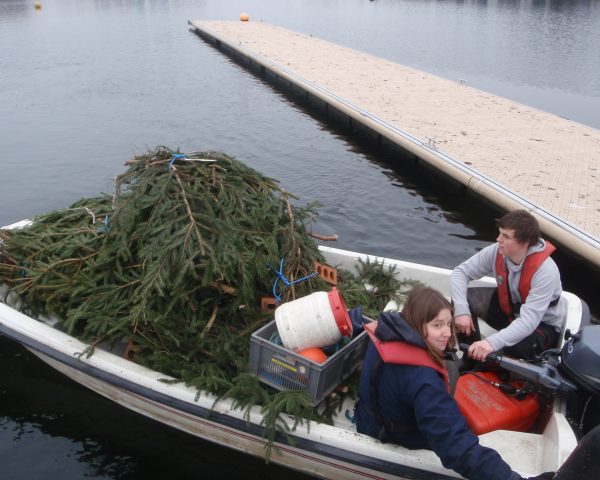
A few of them end up in Salford Quays in Manchester, where scientists use them to gather fish eggs.
Heather Webb, principal scientist at APEM, explained: “The dock basins at Salford Quays are sealed off from the rest of the water and are effectively like giant fish tanks. We’ve been working very closely with Salford City Council to manage the ecology within them for almost 30 years.
“We keep a close eye on the different fish species in the docks and especially the perch.
“Perch spawn earlier in spring and summer than the other species in the docks and females can lay up to 45,000 eggs per kilogram of body weight. When the other species spawn later in the year, the larger juvenile perch will often feed on the eggs or very small young.
“The danger is that the perch would soon become the dominant species. So when they spawn it’s our chance to help keep everything in balance.”
This is where the Christmas trees come in. Like many fish, perch prefer to lay their eggs in amongst the protection of plants and twigs. Bundles of old Christmas trees are ideal.
So for several years scientists from APEM have been carefully placing several dozen of these spawning bundles just beneath the surface of the water.
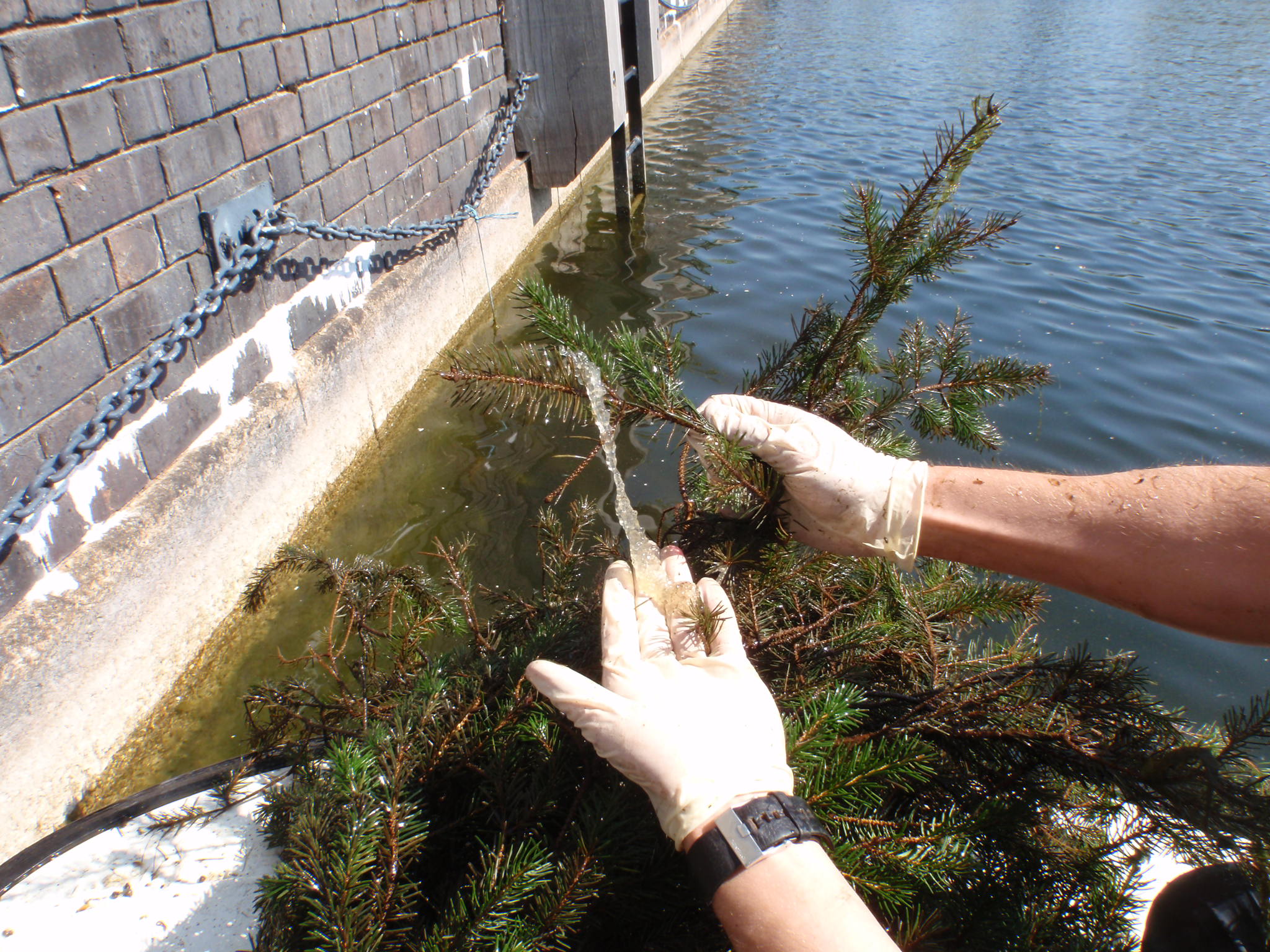
When the scientists return a few weeks later they are able to remove the perch eggs from the branches. Then the bundles are returned to the water for other species to use.
Having to find novel ways to control perch numbers in the dock basins is a problem of success.
Thirty years ago the water was so polluted that no large fish at all could survive. Today, they are teaming not just with perch, but also roach, bream, carp and other species.
The docks lie at the eastern end of the Manchester Ship Canal and while it was a wonder of Victorian engineering and was opened by Queen Victoria, the canal soon became grossly polluted.
Radical measures were required and in the 1980’s scientists from APEM recommended that the massive dock basins should be sealed off from the rest of the Ship Canal, allowing them to be managed separately.
By 1988 the water was becoming clean enough for fish to survive and over 1,000 bream, carp, roach, rudd and tench were released into the basins. The following year 12,000 chub, dace and perch joined them. More fish were stocked into the quays at regular intervals over the next decade.
Peter Dennis, head of APEM’s field scientists, said: “We’re not trying to eradicate the perch, just keep their numbers down a bit. They lay so many eggs that we can never remove them all anyway, so there will always be some young perch hatching out each year.
“The signs are that the Christmas tree bundles are helping us to restore a better balance of fish species to the docks.”

APEM Group today announced further expansion to our Australian business as AARC Environmental Solutions.
+ Read more

We are pleased to announce the appointment of APEM Ltd to the Environment Agency’s fourth generation Ecological Services Framework as an approved contractor
+ Read more

APEM Group today announced further expansion to our Australian business as Attexo joins the group
+ Read more

APEM Group strive to make a tangible contribution to our shared environment, for the benefit of society and all of our stakeholders. Read our ESG report now.
+ Read more